
It’s been a while since I’ve written any sci-fi stuff, so let’s talk about the Asteroid Belt!
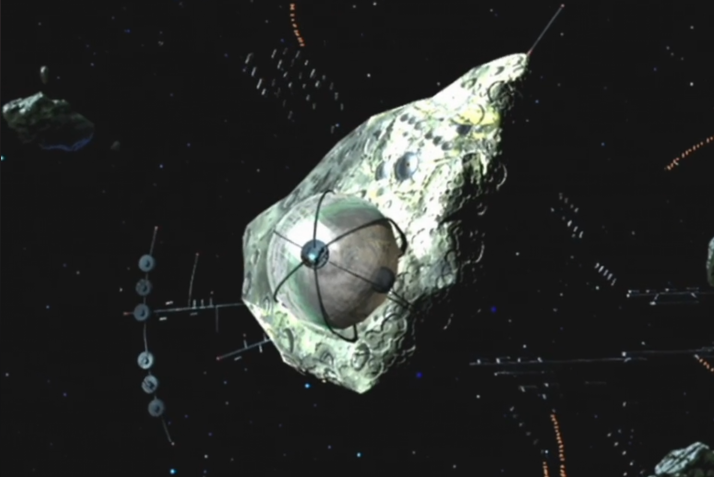
I love the idea of a fully inhabited Solar System. It’s an awesome narrative setting: a sci-fi frontier with, relatively, grounded technology and limitations. There’s less of a fantastical blurring between magic and science, which you get with some sci-fi (no shade though, I like the more fantastical sci-fi’s as well). That opens up a ton of narrative potential.
There’s a disappointing shortage of worlds suitable for terraforming and settlement in our Solar System. I’ve mentioned this before, while talking about Jupiter’s moons. That said, there are plenty of unsuitable places that humanity could settle. And the Asteroid Belt is the most unsuitable of all: no chance of terraforming, negligible gravity, and complete isolation. So let’s do it!
Why, exactly, people would choose to live in the Asteroid Belt is a question in its own right, which I’ll cover in a future article. Here, I want to talk about what an asteroid civilisation would look like. Because, like the moons of Jupiter, it could have some fascinating narrative dynamics.
I’m not the first person to say that. Asteroid colonies, and space cities generally, are a staple of science fiction. For me, the first example that always comes to mind is the asteroid city of Tijuana in the first episode of Cowboy Bebop (that show probably kick-started my obsession with terraforming the solar system). But they show up everywhere, especially in Star Trek.
The Expanse books have an interesting take on the Asteroid Belt as well. In that series, the people of the Belt are an oppressed and exploited nation, caught in the crossfire of Earth and Mars. If I’m honest, though, I am mildly disappointed with this take. It feels a tad predictable, and it leaves some interesting dynamics unexplored. That said, cards on the table, I’m only a couple of books into the series. So that may well improve. They’re also great books, so I don’t want to imply otherwise.
In the Expanse, asteroid civilisation is focused on a handful of stations, chiefly built into the larger asteroids but not exclusively. It also presents the Belt’s population as a singular group: Belters. It does the same with Earth and Mars. To be sure, the Belt has factions and infighting, but it’s still fairly united. There’s a common language and a shared, if chaotic and unrecognised, government. That setting does serve the story, which is the most important thing. I just personally think you can do more with it.
For one thing, the sheer size of the Asteroid Belt means it would have dozens of unique cultures and languages. If not hundreds. It wouldn’t be one nation. It could also have dozens of rival governments with different systems. Some asteroids might be colonies or private factory towns, but others could be independent, and some might be in open rebellion. There could be monarchies, republics, federations, and communes, all of which could overlap.
There could, in turn, be conflict between the asteroids. A few could be safe havens for pirates, whilst others are federalising to crush the pirates. There might even be empire-building asteroids. I like to imagine that the rulers of Ceres (the largest body of the Asteroid Belt) would regard themselves as the rightful rulers of the entire region. In this, they could be bitterly opposed by the other large asteroids. Meanwhile, ideological disputes could be rampant.
The world-building potential is immense.
There’s also room to explore the small asteroids. Most of them aren’t big enough for cities, but there are a million or so asteroids with a diameter of more than 1km. That’s not big, but it’s not insubstantial. A sphere with that diameter would have a surface area of approximately 3km2. Hollowed out, that could house a notable population (here’s a short Reddit thread about population densities in space).
Asteroids aren’t spherical; of course, they don’t have enough gravity for rounding. Still, a hollowed-out asteroid of around 1km in diameter could theoretically host a village of, say, 500 people and could even export food. IRL, the Netherlands exports food despite a density of nearly 500 people per 1km2. Many small asteroids, moreover, have a diameter larger than 1km.
There’s a potential, then, for a sort of asteroid peasantry and rural asteroids that supply the big city asteroids with food. If you turned, say, 100,000 1km asteroids into food-producing settlements with 500 people each, that would be at least 50 million people. That would provide space pirates, smugglers, outlaws and heroes with recruits and hiding places.
There can also be variation in the construction of asteroid settlements. Some can be hollowed-out rocks that spin to create artificial gravity. Others might have surface domes or be attached to O’Neill cylinders (large spinning space stations). Or all three. Some asteroids, meanwhile, might be cobbled together to create larger stations, and where suitable, comets might be interwoven with genetically modified plants to emit breathable air (a Dyson tree). There can also, of course, be a fleet of space stations mixed in.
In short, a ton of cool stuff can be done with the Asteroid Belt, and there are loads of great stories that can be told there. And not inexplicably. The Asteroid Belt, as a narrative setting, can be a sci-fi realm, a disputed frontier, and an archipelago all at once. It means a vast number of genres and ideas can be played with and combined. Personally, I want to write a whole host of short stories in the Asteroid Belt. I’ve even been thinking of putting some of them on this website.
-Dexter

 Thoughts and Fiction
Leave a reply to Why Will Humanity Settle The Solar System? – Thoughts and Fiction Cancel reply