
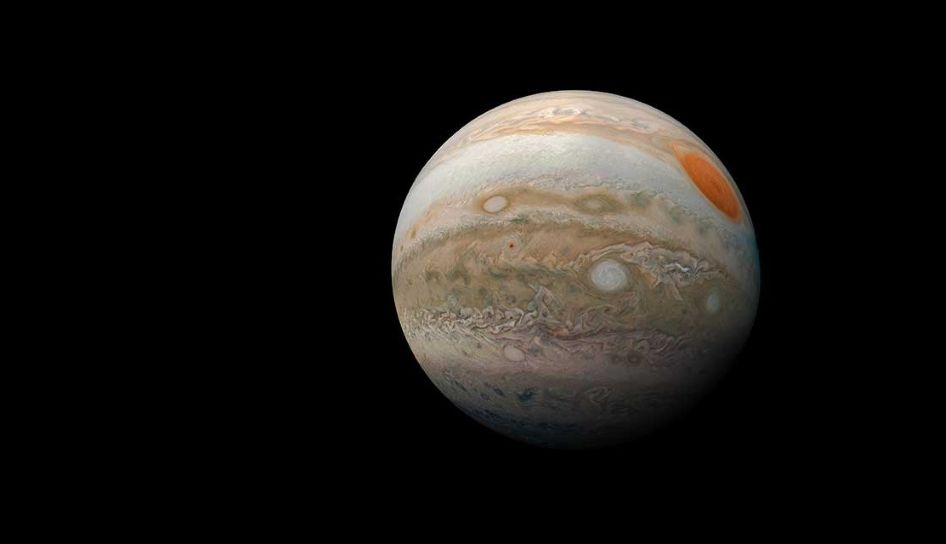
I once heard it said, I think on a forum, that the Jovian System (Jupiter and its moons) is an empire waiting to exist. That has stuck in my mind. Its narrative potential, as well, is almost endless. There is so much world-building that you could do, and so many cool Sci-Fi themes you could explore.
I’ve talked about terraforming other planets and moons before, but I’ve got to admit, the Solar System has a disappointingly small number of candidates. This isn’t a take-back, I’m still fully onboard with the idea of terraforming. The idea of a habitable solar system, where you can live on any of the vastly different worlds without relying on life support equipment and identical metal habitats, is just too cool. It embodies fantasy, adventure, exploration and even independence (given the impossibility of instant communication). That’s the allure of Sci-Fi’s like Star Trek as well. But, sadly, most of the objects in our solar system are either too small (like asteroids and most moons) or horrifyingly large, like the gas giants.
That doesn’t mean you can’t create a cool Sci-Fi setting in our solar system. Nor does it mean that sealed asteroid colonies can’t be used in a story. But it does mean that a story in our Solar System won’t have hundreds of fully terraformed, habitable worlds (unless the tech is really advanced). Most of the colonies and settlements would have to rely on artificial environments and risk (though it is avoidable), being identical and a little depressing. Spare a thought for the permanent cabin fever of future asteroid colonists. Don’t get me wrong, asteroid colonies are a cool setting. But better to have them side-by-side with terraformed planets, no?
Enter the Jovian System!
Most of the moons that orbit gas giants are, again, disappointingly small; they’re often captured asteroids. Not a lot you can do with them from a narrative standpoint (beyond the obvious outposts, prisons and mines). Still, the gas giants do have some suitably large moons that could, in theory, be terraformed and developed into complex societies. Saturn, for instance, has the moon of Titan. The Jovian System, meanwhile, has the Galilean moons. So named because they were the moons that Galileo first observed.
The four Galilean moons (Ganymede, Europa, Callisto and Io) are, to my mind, prime candidates for terraforming and/or settlement. Except Io, which is doused in radiation and might be the worst place in the Solar System. Admittedly, there are issues with these moons.
Some Sci-Fi enthusiasts may object that terraforming Ganymede, Europa, and Callisto (ice moons) would result in ocean worlds. That’s true, but I’m undeterred. For one thing, an ocean world can itself be a cool narrative setting. This is how Cowboy Bebop depicts Ganymede. Besides, there are multiple narrative ways of dealing with the ice/ocean problem, and that can be worked into the lore. Perhaps one moon became an ocean world whilst another insulated the ice and then placed soil and air on top of it.

The Galilean moons don’t have the highest levels of gravity either. It is better than on other moons and asteroids, though. To my understanding, we don’t really know about the health effects of a low-gravity planet or moon (we just know that zero gravity is harmful). Still, I imagine that futuristic societies would have some way of dealing with gravity-related health effects. In the Expanse books, asteroid colonists (Belters) have drugs and medicines for developing healthy bone and muscle densities.
Once those problems have been resolved, however, with a host of Sci-Fi technologies, the moons have a ton of potential. For one thing, they’re large enough to host a multitude of towns and cities. Ganymede is actually larger than the planet Mercury; its weaker gravity is a result of its low density. They’ve enough surface area for a ton of provinces, regions and general world-building (literal and narrative). The moons could even have multiple nations with unique cultures and histories. That raises further questions. How do the different cities and regions of Ganymede relate to each other? How do they relate to the other Galilean moons and Jupiter as well?
This is true of most terrafomed planets and large moons, of course. They could all have multiple cultures and regions. But each world has unique characteristics, geographies and specific challenges that could inform the lore. There’s cool stuff you could do for each of them. What’s unique about Jupiter and its Galilean moons is that they’re so close to each other. Most of the planets available for terraforming are dispersed throughout the Solar System, requiring months or even years of travel. The four worlds of the Jovian System are mere days away from each other.
The governments and peoples of Callisto and Europa, that is, would not be isolated and self-reliant in the same way that Mars and Titan would be. Not when they’re in spitting distance of Ganymede and Io. Diplomats, merchants and warships could move constantly between the Galilean moons (and wouldn’t even need particularly sophisticated spaceships). Each moon would be its own seat of power, insulated from the problems of the other moons by the inherent difficulty of space travel, and yet constantly enmeshed with them.
The politics of the Jovian System could be fascinating and is ripe with narrative potential. Do the moons want to be independent? Are their warlords trying to unite them? Do they have historic rivalries and regular sporting competitions? And that’s without considering the other elements of the Jovian System. There would also be outposts, mines and sealed habitats in the smaller moons, and even cloud colonies in the upper atmosphere of Jupiter (where the gravity isn’t too crushing).
It’s not just the politics that’s interesting, either. The Galilean moons are widely considered to be our best bet for finding extraterrestrial life (especially Europa) due to their water, carbon and volcanic activity. This possibility would undoubtedly impact the societal development of any settlements. Moreover, whenever the Galilean peoples look up at the sky, they would see the horrifying monster that is the planet Jupiter. Even if there’s no alien life, the Jovian System would have a lot of interesting religions.
In summary, then, the Jovian System is awesome, and its narrative potential is immense. Its political situation would be unique within the broader Solar System, and it could host a vast network of intertangled cultures and religions. There are a lot of stories you could tell about the Jovian System. I have a few story ideas myself. It is an empire waiting to exist.
-Dexter

 Thoughts and Fiction
Leave a comment