
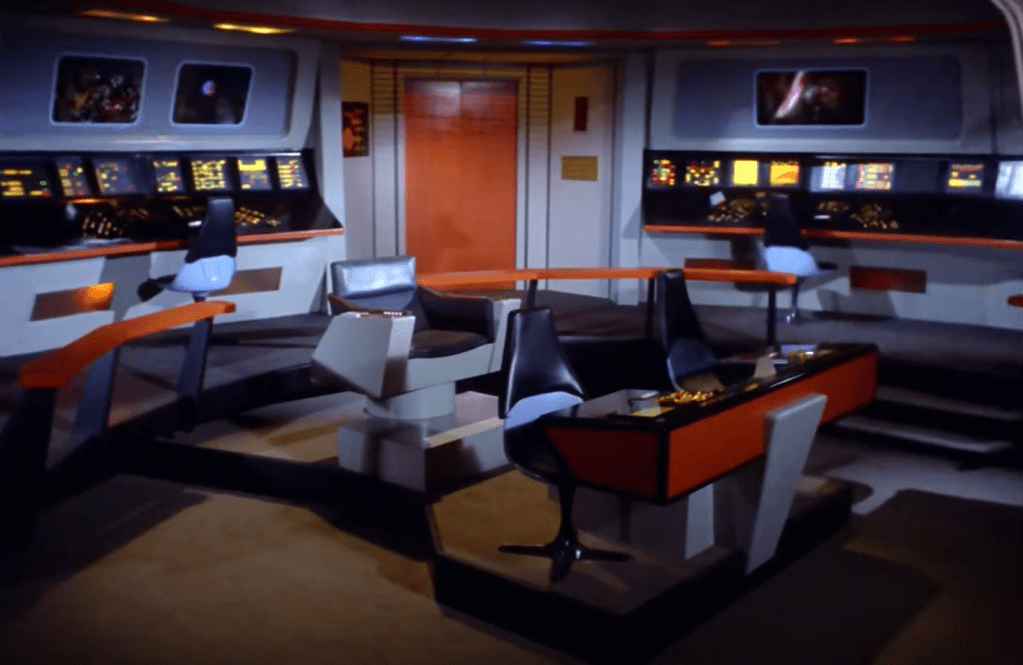
In the Science Fiction movies and TV shows of the ‘60s, ‘70s and ‘80s, there’s often a strange blend of futuristic equipment and non-futuristic aesthetics. They even have technology that’s outdated in our time.
From Star Trek to Alien, future technology is bulky and obsolete; they don’t have graphical computers, and everything is controlled with buttons and levers. Even in Star Wars, the control schemes are analogue, and the video displays are black and white. The Galactic Empire has holograms but not colour TV.
I’m guessing this was largely a production footprint. They were implementing equipment and technologies into the sets that, at the time, were new, cutting edge and seemed futuristic. It seems like an anachronism now because our technology has improved. In some ways (but sadly not others), we’re more advanced than the Sci-Fi societies they imagined.
There is an aesthetic charm to it. I think we sometimes include retro tech in modern Sci-Fi because so many great Sci-Fi stories have it. Anachronistic technology is in the DNA of Science Fiction. It’s part of the visual appeal. This also applies to clothing and décor. In Alien, for example, it is the future, but there’s something very ‘70s about their clothing.
For the most part, this retro technology and aesthetic doesn’t factor into the story. It’s a purely aesthetic feature that’s easy to overlook. But sometimes, it does have an impact.
Tape in Classic Doctor Who
The other day, I was watching an episode of classic Doctor Who (Revenge of the Cybermen with Tom Baker), and there was this glaring moment where retro technology affected the plot. It was a small moment, but it was all I could think about afterwards.
The story takes place on a military space station in the 25th century, that the Cybermen are planning to attack. To weaken the human crew, the Cybermen have deployed a ‘virus’ on the station (it’s actually a small robot, CyberMat, that injects people with poison). They also have a human accomplice.
Whenever the space station detects something or talks to someone, a technician makes a record/log of it. And they record that information… on tape.
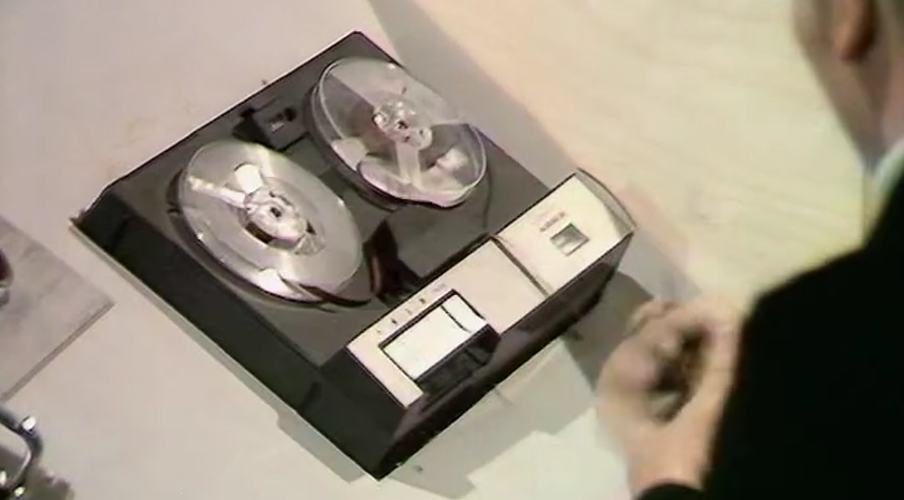
After the Cybermen’s plan is nearly discovered (some incriminating data is recorded), the CyberMat and saboteur kill the technician and tear out the tape.
The surviving crew members find the technician and assume he’s been infected with the virus. But the Doctor points out that a virus can’t tear out or break tape. This is how they realise that the space station is being sabotaged/is under attack.
The fact that everything is being recorded on tape is, as such, vital to the story. Admittedly, it’s not the essential element; they could have done something similar with digital recordings. Still, Earth’s space forces recording everything on tape – in the 25th century – does factor into the story.
It’s a glaring anachronism, and I couldn’t stop thinking about it, not least because the space station is shown, in other episodes, to be in operation for centuries. It would have to be a very robust, long-lasting bit of tape.
That said, there might be an in-universe explanation for why they would record everything on tape.
The Digital Dark Age
Our records and information are often stored in digital formats, which is convenient but does present a long-term issue. Digital records require constant maintenance. They need to be updated to new formats, and the physical hardware (SSDs and such) does deteriorate. Without maintenance, data will eventually be lost.
The digital dark age idea posits that we could ultimately lose a vast quantity of historical data and knowledge because of this. If we don’t, or can’t, continue our constant and expensive maintenance of the digital infrastructure, we may blunder into another dark age.
On the surface, it seems like a cool setting for a Sci-Fi/post-apocalypse story, but it is something that could happen. Some data has already been lost.
Conversely, physical and ‘low-tech’ records are surprisingly robust, albeit less convenient. Paper, velum and even clay tablets (if they got exposed to fire) can last for thousands of years. Their surprising endurance has allowed archaeologists to construct a much fuller picture of our ancient past than otherwise possible.
The Future Advantages of Tape
As it turns out, tape is a surprisingly robust method of data storage. It lasts longer than other digital records and doesn’t require constant energy. It’s actually still used for that reason. It might be that future societies will fully embrace this.
In a space-faring civilisation, long-term data storage is an immediate problem. If you have to deal with interstellar distances, you’ll have to think in ‘interstellar’ times. Governments, organisations and ships could be operating continuously for thousands of years.
That’s not unheard of in human history (Bronze Age bureaucracies operated non-stop for millennia), but it does demand robust data storage. Especially if the astronauts are entering cryogenic sleep for years at a time, they’ll need to ensure the ship’s memory won’t deteriorate.
The surprisingly long-term robustness of tape is an obvious solution. Tape can keep the ship’s memory intact for drawn-out stretches of time.
A Retro Development of Technology?
I’m not the first person to have this thought (which I only found out after writing this). But the idea can go pretty far.
Tape still strikes me as fragile, and I doubt it could last centuries. The Doctor Who episode emphasises this: the tape gets torn out by hand. But then, in the future, there might be new, highly durable forms of tape that can last, assuming no sabotage, for millennia.
Maybe, in all the old sci-fi films that use tape, like Doctor Who and Alien, it only looks like contemporary tape.
Maybe it uses the same principles as tape and works in a similar way but conceals some futuristic materials and novel methods of reading the tape: a blending of past ideas and new technology rather than a complete reversion to retro tech.
This can be extended to every piece of retro Sci-Fi technology.
The more straightforward a piece of equipment is, the less there is to go wrong. Simplicity also makes it easier to fix, which is handy when you’re light-years from the nearest repair shop. “Keep it simple, stupid”, as they say in the military.
This goes for the ship controls as well. You don’t want to deal with a faulty touchscreen when you’re between solar systems. Mechanical and analogue controls, buttons, levers and gauges might look less impressive, but they might also be reliable and more easily repaired.
Space travellers might also minimise their reliance on vulnerable technology by simplifying their ship computers, hence the lack of a graphical user face in some Sci-Fi films.
Moreover, any designs that are minimalist and sleek but, subsequently, fragile and delicate would be replaced with something bulky and difficult to break. (It’s the invincibility of a Nokia brick over the fragile iPhone screen.)
Final Thought
The appearance of retro technology often seems anachronistic in Sci-Fi movies and shows. It can be charming, and it’s in the DNA of Science Fiction, but it often feels out of place.
I’m increasingly convinced, however, that it makes perfect sense for a space-faring civilisation.
If you were a space traveller, you wouldn’t want to rely on digital records that may deteriorate whilst you’re in suspended animation; you’d want robust records that can last decades or centuries. You wouldn’t want to rely on digital controls or fragile touchscreens either; you would want mechanical and analogue controls that are easy to repair.
Anything superfluous to the ship’s function would increase the number of things that could break. You’d do away with them.
In short, for the rigours of space travel, simple, robust and clunky equipment is probably preferable to the sleek and easily broken tech that we currently use.
Future space travellers will have very different technological requirements to us. But the retro-appearing technology used in a lot of Science Fiction – which may conceal future materials – seems to suit their needs pretty well.
-Dexter
 Thoughts and Fiction
Leave a comment