
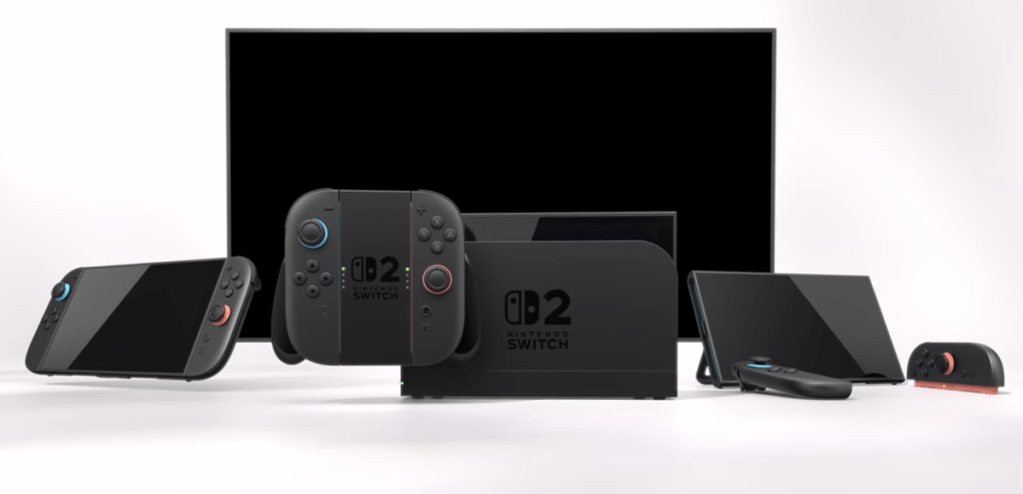
The Switch 2 looks amazing, I’ve certainly sung its praises. But if there’s been one major drag on the announcement, it’s the price. The Switch 2 is expensive. And Nintendo knows that it’s expensive.
They didn’t even mention its pricing during the launch presentation (an essential part of any ad) and practically every comment on the Treehouse livestream was a demand to drop the price.
I suspect, as well, that this points to some much broader problems in the video game industry.
So, let’s talk about it.
(This article is going to be a bit of a downer, I think.)
The Console
The Switch 2, by itself, comes in at $449.99. For an extra $50 you can get it bundled with Mario Kart World, at $499.99. It’s a hard pill to swallow (it’s over $100 more than the Switch 1). To some extent, I understand that better technology justifies a higher price tag. Though $100+ more seems like pushing it.
I have to wonder how large the markup is.
Nintendo likes to make a profit on hardware (other companies sell the hardware at a loss and make money on the games). I do get that. Nintendo is a company and does need to make a profit (especially since their competitors do more than just video games).
But still, I wonder about the markup. Because again, it is very expensive. I wouldn’t be surprised if the markup had increased since Switch 1.
Switch 2 will be about $100 cheaper in Japan. It’s region-locked to prevent traders from bulk buying in Japan and selling them across the world.
There’s probably a few things going on here. Japan has been through multiple decades of deflation (kind of like the reverse of inflation – and even worse), so prices are generally lower there. Switch 2’s standard international price is, subsequently, a seriously large amount of money in Japan (more so than in other countries).
On top of that, Japan is Nintendo’s home market – and an essential market at that. It counted for a sizeable portion of Switch 1 sales. Naturally, it’s a market that Nintendo is inclined to prioritise and give special attention to.
Assuming, however, that Nintendo still intends to profit from the consoles it sells in Japan (and it is possible that they’re selling at a loss), it suggests that the markup for other countries is substantial.
The Games
Perhaps the real gut punch has to do with the games. They’re expensive, and a lot of Nintendo’s decisions are questionable (why did they not announce a new 3D Mario?)
First of all, Welcome Tour: the most tech-demo-esc tech demo they’ve ever made. It looks like a cool way to show off the console. But why are they charging for it? It’s not the kind of thing anyone is likely to play more than once or twice. It’s certainly not something that anyone would pay extra for. It should come pre-installed. Making it a paid optional extra is baffling.
On the topic of baffling decisions, I don’t think Kirby Air Riders is going to do very well. Don’t get me wrong, I’m thrilled that they’ve made it. I loved the original and I play it a lot. I’m also thrilled that Sakurai has returned. But releasing two first party racing games in close proximity to each other does not seem like a good idea.
If the average consumer has to choose between Mario Kart (bundled with the console) and the sequel to a comparatively obscure 20 year old racing game, they’ll choose Mario Kart. They’ve yet to reveal the price of Kirby Air Riders, but a high price tag would next to guarantee its underperformance.
Game Prices
Mario Kart World, which looks to be their ‘killer app,’ is likewise going to be pricy. Individually, it will retail at $79.99. Premier Switch 1 games, like Tears of the Kingdom, are often about $69.99 (most games are around $59.99). So, we’re probably looking at a $10 increase for games.
This is in line with Nintendo’s offer to upgrade certain Switch 1 games to their Switch 2 edition for a $10 payment. The new Donkey Kong game points to this as well. At $69.99, it’s again $10 more than the bulk of Switch 1 games.
A $10 price increase might, initially, seem reasonable. Video game development has gotten more expensive and prices are going up everywhere (GTA 6 could be $100).
However, the Switch 2 – Mario Kart bundle only costs $50 more than the Switch 2. That means you can get Mario Kart World for $30 less than its individual price. Assuming, again, that Nintendo isn’t selling it at a loss, the standard $79.99 price tag seems a sizeable markup.
Most people will buy the cheaper bundled edition, and the simultaneous announcement of both editions suggests that Nintendo wants people to. This presumably means that they expect to make a healthy profit on Mario Kart World at the bundled $50 price tag. The $79.99 price tag sticks out like a sore thumb.
Nintendo’s cycle
Looking back on Nintendo’s history, they seem to go through this strange cycle of success, arrogance, and collapse. This isn’t a hard rule, mind you, just a casual observation.
When things are going well, it goes to their heads. They overplay their hand with nonsensical moves and things start going badly. Hurt and humbled, they rethink their approach, and things start to work out again.
The NES and SNES were successful. The N64 and GameCube, though beloved, were not. Some of this was due to bad planning and the difficulty of switching to 3D game development.
But some of the pain was self-inflicted. In the N64 era, they created one of their biggest competitors – Play Station – after a deal with Sony to develop disc drives fell through.
In the Game Cube era, they were so worried about piracy that they refused to use ordinary mass-produced disks, as the more successful PS2 did. Instead, they made their own proprietary disks that couldn’t hold enough data for most games. The result was a serious lack of third-party support.
Nintendo then pivoted to the Wii, a runaway success, and followed that with the Wii U, a massive flop that they bungled in a lot of ways (I won’t go into specifics here).
The point is that they have massive ups – facilitated by innovation and incredible game design – and they have massive lows, which are often self-inflicted. Given the apparent pricing problem, I’m a little worried that Nintendo may repeat this cycle.
When Nintendo isn’t doing so well, they often become more appreciative of the die-hard fans, I think. That’s probably why the less successful consoles, like the N64 and Game Cube, are so beloved. Nintendo does everything it can to keep the die-hard fans loyal.
When Nintendo is doing well, however, they tend to become anti-consumer and take their fans for granted. Again, this isn’t a hard fact. Just an observation. But the behavior does, I suspect, extend to their pricing.
When the 3DS first launched, it struggled. This, I suspect, was symptomatic of Nintendo’s spiral. Their previous handheld, the DS, was a massive success (second best-selling console ever), and that success once more went to their heads.
I think they just assumed DS users would buy the follow up. They did not.
The 3DS was salvaged with a price cut (earlier adopters were compensated with a host of exclusive games) and the release of several big games. The 3DS ended up having a pretty successful life. It basically propped up Nintendo during the Wii U era.
It’s tempting to think that something similar might happen with Switch 2. If the price tag (and the surprisingly low number of first-party titles) results in a difficult launch, they may respond with a price cut. They would, in that situation, probably offer a host of free games and/or a Switch Online subscription to the early adopters.
But I don’t think that’s going to happen. We’ve got to talk about the elephant in the room.
Tariffs
Gaming, for me and many others, is an escape from the world’s problems. But sometimes the world’s problems can’t be escaped from. Even for an hour or two.
The US has imposed a slew of tariffs across the world. There’s a base rate of 10% on all countries (and 25% on Steel, Aluminium and Cars) and a host of extra tariffs on specific countries. No one has been spared.
They’ve even put tariffs on an uninhabited island, containing only penguins, that the US apparently buys electrical goods from. (They’re very industrious penguins, I guess.)
Everyone knew these tariffs were coming, and Nintendo would have undoubtedly factored that in. Although Nintendo has denied that this is reflected in their prices.
Still, I don’t think anyone expected the tariffs to be this bad. Nintendo certainly didn’t.
The Switch 2 is primarily manufactured in Vietnam, which has been hit especially badly. So much so, that Nintendo has actually stopped pre-orders in the US, presumably while the Nintendo executives freak out and try to come up with a solution.
It is unfortunate for Nintendo that the tariffs were announced on the same day as the Switch 2 presentation. To think on it, that might be why they didn’t reveal their price during the presentation. It gave them a few extra minutes to revise their prices as the tariffs unfolded.
As bad as things look for Nintendo (and also everyone else on Earth) things might get worse. This could erupt into a full-blown trade war. Retaliatory tariffs will be met with more retaliatory tariffs. And that means prices could get very high. For everything. Not just the Switch 2. This is already happening.
It’s been speculated that the Switch 2’s price might, as a result of the tariffs, be increased by well over $100.
To some extent, the Switch 2 price controversy is a case of bad timing. They’re the first big company to unveil a major new product in the wake of the tariff announcement (same day no less). The price is, subsequently, noticeable.
But it won’t be an outlier.
There is no doubt in my mind that the next Play Station, Xbox, and that new Sega/SteamDeck hybrid, will also be obscenely expensive. Nintendo was the first. They won’t be the last.
As a curious side note, the pre-order freeze and tariff related price hikes could mean that the Switch 1 ends up selling more units than the PS2. Trade difficulties were one of the reasons that the PS2 did so well. It meant that Sony kept supporting it for years. The same could now happen in the US.
Ordinarily, a massive Switch victory in the console wars would be a source of jubilation for Nintendo fans. But given the context in which it’s happening, that seems unlikely.
Cost of Living
Video games have always been an expensive hobby, but it did get a bit cheaper for a while.
Buying a video game in the 80s and 90s was a much larger investment than it has been in recent times. Changes in the value of money (inflation) do hide the fact a little, but gaming was more expensive then.
In that regard, you could say that gaming is reverting to its prior expense. I’ve seen a few people make this point about Switch 2. But the situations aren’t the same. The difference now is that the cost of living has gotten higher.
In the 80s and 90s, an NES, SNES, or any other console was expensive. But food, rent, and general existence were comparatively cheap. So it kind of worked out. People could afford to occasionally splurge on an expensive hobby because staying alive didn’t cost as much.
The current video game price increase, of which Switch 2 is becoming symbolic, is occurring at a time when rent, food, and general existence are also expensive. This is obviously bad for humanity in general. It’s also self-destructive for the video game industry.
If video game companies and developers think the average consumer will buy a ton of expensive video games instead of food, they’re wrong.
In this economy, the video game industry just straight up can’t charge very much and will collapse if it tries. Sure enough, there have been a lot of studio closures and developer layoffs in recent years. The problem, basically, is wealth inequality.
A lot of wealth has been stockpiled at the top, which doesn’t leave the average consumer with enough money for essential spending.
When people don’t have enough money to survive, luxury spending (and video games fall into this category) is naturally the first thing that people stop. (The super-rich beneficiaries of inequality only spend a small portion of their overall income, so they can’t make up the shortfall in demand. The economic jargon for this is Marginal Propensity to Consume).
Conclusion
The video game industry’s determination to increase its prices, a lot of which is probably a markup, is unsustainable. The cost of living has gotten too high. Nintendo is obviously guilty of this: they clearly have a large markup and almost never put their games on sale. But it’s an industry-wide problem.
The Switch 2 has, so far, been a glaring example of this tendency in the game industry. The Switch 1’s success has, I think, gone to Nintendo’s head and, in their ongoing cycle of arrogance, has caused them to massively increase the price during a cost-of-living crisis. Alongside a slew of other baffling decisions.
Ordinarily, this might lead to something of a humbling and a subsequent price cut. But not this time.
The new tariff regime will undoubtedly force the price up even further. And that might be the straw that breaks the camel’s back. Not just for Nintendo but for the entire video game industry. The Switch 2, in this regard, may just be the canary in the coal mine.
-Dexter

 Thoughts and Fiction
Leave a comment